How Medra Writes Your Thesis with AI in 10 Minutes
By Équipe MedraPublished on
Writing a thesis or dissertation is an intellectual marathon requiring time, rigor, and unwavering motivation. Between documentary research, structuring ideas, writing, and revisions, many students feel overwhelmed. What if technology could transform this obstacle course into a sprint? This is the promise of Medra, an AI-powered academic writing assistant capable of generating a complete thesis draft in under 10 minutes. This article reveals, step by step, how this revolution is possible.
| Key Takeaway | Details |
|---|---|
| What is it? | Medra is an AI tool designed to help students generate complete theses, dissertations, and academic papers, from introduction to bibliography. |
| Why is it important? | It offers significant time savings, helps overcome writer's block, and provides a structured, solid foundation for high-quality work. |
| Who is it for? | For all higher education students (Bachelor's, Master's, PhD) looking to optimize their writing process and focus on critical analysis rather than drafting work. |
What is Medra, Your AI Writing Assistant?
Medra is much more than just a spell checker. It is an advanced artificial intelligence, specialized in the academic world. Its primary goal is to assist students in creating complex research papers. By leveraging state-of-the-art Natural Language Processing (NLP) algorithms, Medra analyzes your topic, conducts research in academic databases, and drafts coherent, structured, and relevant content. It's a writing partner that handles the most laborious tasks, allowing you to focus on the core of your research: analysis and argumentation.

How Medra Generates a Complete Thesis in Under 10 Minutes? The Step-by-Step Guide
The promise of generating a thesis in such little time may seem unrealistic. However, the process is logical and structured. Here's how Medra achieves this technological feat.
Step 1: Project Initialization
It all starts with a simple and intuitive interface. After registering on the Medra platform, you create a new project. The first step is to provide the basic information for your work: your thesis topic, your research problem or question, and main keywords. The more precise you are at this stage, the more relevant the final result will be.
Step 2: Defining the Structure and Plan
Medra doesn't just write random text. The AI suggests a classic thesis structure (Introduction, Literature Review, Methodology, Results, Discussion, Conclusion) that you can customize. You can add, delete, or rearrange chapters and sections according to your university's requirements and the specifics of your topic. This flexibility ensures that the generated document will perfectly match your expectations.
💡 Pro Tip
For optimal results, prepare a clear research question and a list of 3 to 5 main points or arguments you wish to address in your thesis. Providing this initial plan to Medra will guide the AI for even more targeted and relevant content generation.
Step 3: The Magic of AI Generation
Once the structure is validated, the core of the process begins. Medra's AI gets to work. It analyzes thousands of academic sources (journal articles, books, conference proceedings) to collect the most relevant information related to your topic. Thanks to its synthesis capabilities, it organizes this information and begins the automatic thesis generation, section by section.
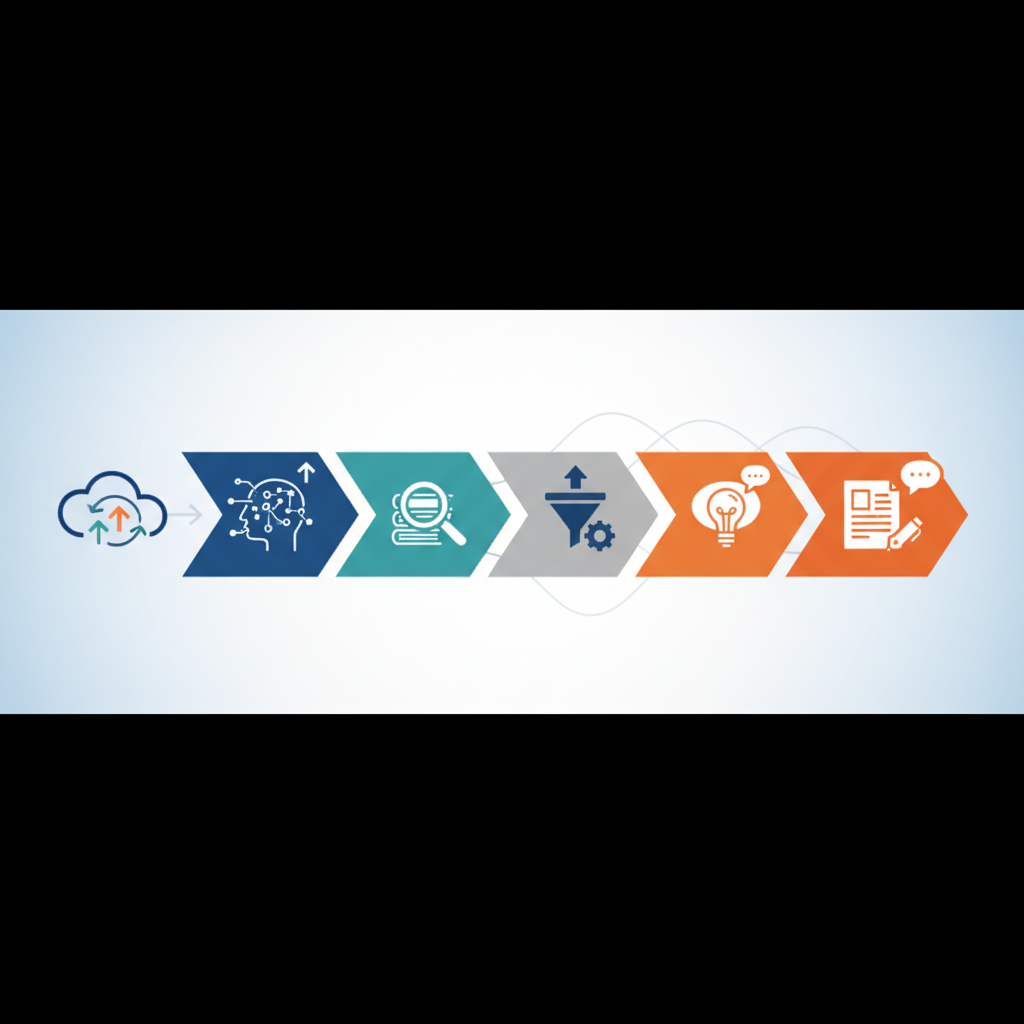
Step 4: Coherent Writing and Integrated Citations
Medra writes each part of your thesis fluently and academically. The introduction sets out the problem, the literature review synthesizes existing knowledge, the methodology describes the research approach, etc. Crucial point: throughout the writing, the AI integrates citations and compiles a bibliography. You can choose your citation style (APA, MLA, Chicago, etc.), and Medra handles the formatting, saving you hours of tedious work.
Step 5: Personalization and Finalization
In less than 10 minutes, Medra delivers a complete first draft of your thesis. It's essential to understand that this document is an extremely solid working basis, not a final product to be submitted as is. This is where your role as a student and researcher takes on its full meaning. You must appropriate the text, reread it, correct it, add your own voice, your critical analyses, and your personal reflections. Medra is an assistant, not a replacement.
Why is AI Thesis Generation So Important?
Medra's approach is not just about speeding up writing; it transforms how students approach research.
- Massive time savings: Freed from writing the first draft, students can dedicate more time to in-depth research, experimentation, and critical analysis of results.
- Combating writer's block: The blank page is the enemy of many students. Medra provides a structure and starting content, making the process much less intimidating.
- Improved structure: AI ensures a logical plan and coherent progression of ideas, points often difficult for novice writers to master.
- Access to expanded documentary research: Medra can scan and synthesize a much larger volume of literature than a human could process in a limited time, thereby enriching the theoretical basis of the thesis.
To learn more about modern writing techniques, feel free to read more on our blog.

Misconceptions About Automatic Thesis Generation
The emergence of tools like Medra's AI thesis generator raises legitimate questions. It's important to clarify some common misconceptions.
- "It's plagiarism." False. Medra generates unique content for each user and cites its sources. However, the ultimate responsibility for verifying originality and correctly citing all ideas that are not your own rests with you. The tool is designed to respect academic integrity, but it requires human supervision.
- "The content is generic and soulless." False. If the AI provides the skeleton and the flesh, it's up to the student to breathe life into it. Medra's document is a starting point. Your work of personalization, adding specific examples, and personal analyses will make it unique and relevant.
- "It prevents the student from learning." On the contrary. By automating repetitive tasks, Medra frees up cognitive time for higher-value activities: critical thinking, data interpretation, and the construction of original argumentation.
Summary: A New Era for Academic Writing
The automatic thesis generation by tools like Medra is not science fiction. It's an accessible reality that redefines the rules of student productivity. By following a simple multi-step process, Medra transforms weeks of labor into a solid draft obtained in under 10 minutes. Far from replacing human intellect, this technology acts as a powerful catalyst, allowing students to focus on what truly matters: the production of original and relevant knowledge. Ready to transform your writing experience? Try Medra today.
⭐ Recommended Resources
How to Choose a Thesis Topic with AI – A guide to finding the perfect topic with the help of artificial intelligence.
Avoiding Plagiarism When Writing with AI – Best practices to ensure the originality of your work.
Discover Medra – AI assistant for academic writing.
Is using Medra considered cheating?
No, provided you use it as a writing assistant and not as a substitute for your own work. Universities have policies on academic integrity. Medra is a tool to generate a first draft, find sources, and structure your ideas. It is your responsibility to verify, modify, and especially add your own critical analysis to make it your original work.
Is the bibliography generated by Medra reliable?
Medra strives to use credible academic sources and format citations correctly. However, as with any technology, errors can occur. It is imperative to verify each cited source to ensure its relevance and the accuracy of the reference. Consider the generated bibliography as an excellent starting point for your own verification work.
Can I use Medra for any field of study?
Yes, Medra is designed to be versatile and can handle a wide range of topics across multiple disciplines, from social sciences and humanities to exact sciences. Its ability to analyze millions of publications allows it to adapt to very specific fields. For extremely niche or very recent topics, your supervision and contribution of supplementary sources will be even more important.
What are the limitations of automatic thesis generation?
The main limitation is the absence of true understanding and personal experience. An AI cannot conduct interviews, perform laboratory experiments, or have a personal opinion. The generated content is based on existing textual data. This is why human intervention is crucial to add the context, interpretation of raw data, and critical argumentation that make a thesis valuable.
- mémoire IA
- Medra
- génération automatique mémoire
- rédaction académique
- thèse
- intelligence artificielle
- productivité étudiant